
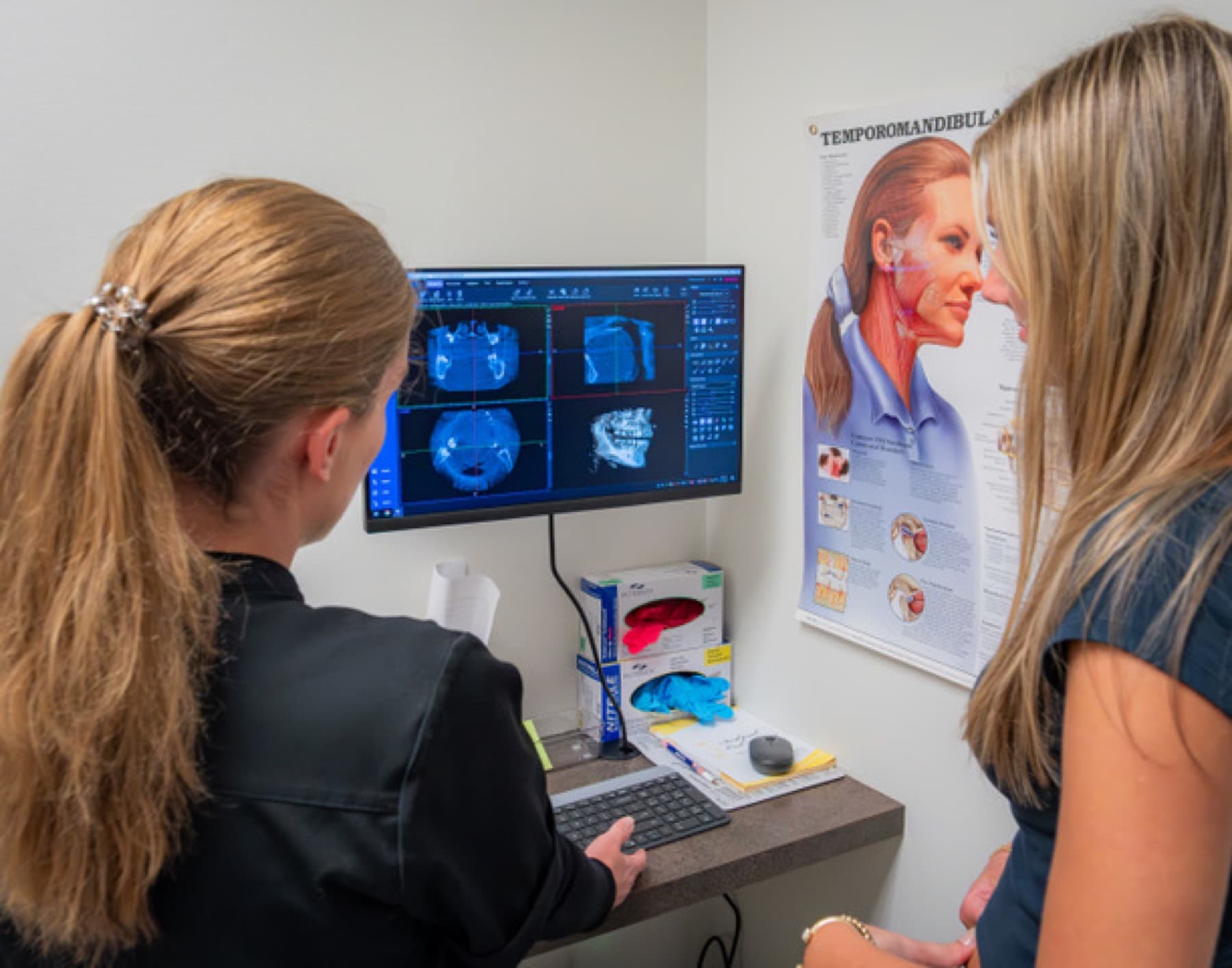
Electromyography · Charlotte, NC
Measuring how your jaw muscles really work
Lasting relief starts with understanding the problem. Electromyography (EMG) measures the activity of your jaw muscles, giving us objective data to base your TMJ care on — not guesswork.
5.0 · 301 Google reviews- LVI Fellow · Neuromuscular
- Charlotte's EMFACE Provider
- 20+ Years in Dilworth
Why measuring the muscles matters
Your jaw is powered by muscles, and when they’re strained or working against a poor bite, they can cause pain, tension, and headaches. EMG lets us see how those muscles are actually behaving.
That objective picture is part of the neuromuscular approach: understand the cause precisely, then build a conservative plan around it.
What EMG is like
EMG is a comfortable, non-invasive measurement — small sensors rest on the skin over your jaw and facial muscles and simply listen to their electrical activity while you rest, close, and chew. Nothing is inserted and nothing hurts; it takes only a few minutes and gives us a real recording of how hard your muscles are working and whether they’re balanced.
How EMG guides your TMJ care
Numbers turn a hunch into a plan. If EMG shows that certain muscles are overworking or that the two sides of your jaw are firing unevenly, that tells us where the strain is coming from and how to relieve it — and it gives us a baseline to measure improvement against as treatment progresses. Paired with a [T-Scan bite evaluation](/t-scan-digital-bite-evaluation/), it’s how we plan [TMJ treatment](/tmj-treatment/) around what your jaw is actually doing rather than a guess.
Common questions
- By recording how your jaw and facial muscles behave at rest and in motion, EMG helps identify TMJ-related muscular issues, clenching and bruxism, facial or jaw muscle fatigue, imbalanced bite forces, and the muscle tension behind headaches and neck pain.
- No — EMG is a non-invasive measurement of muscle activity. It’s a comfortable diagnostic step that helps us understand your jaw before recommending treatment.
- Because TMD often involves how the jaw muscles and bite work together. Measuring gives us data to plan care precisely, rather than guessing.
Related care
Areas we serve
Caring for Charlotte, from our home in Dilworth
Our office sits on East Blvd in Charlotte’s Dilworth neighborhood, so we’re a short trip for patients across the city’s urban core and greater Mecklenburg County.